
Funding considerations
As the plan sponsors, Ontario Teachers’ Federation (OTF) and the Ontario government must consider a range of factors and risks when considering the long-term financial health of the plan.

$31.2B
funding surplus
11%
average contribution rate per plan sponsor
100%
inflation protection on all pensions
As the plan sponsors, Ontario Teachers’ Federation (OTF) and the Ontario government must consider a range of factors and risks when considering the long-term financial health of the plan.
The pension plan continues to evolve to meet changing economic and demographic factors. A record of changes in contribution rates, pension benefits and inflation protection levels can be found below, along with a summary of decisions made to address funding shortfalls or surpluses since the pension plan became an independent entity in 1990.


A: Yes. Members can rest assured that their pension payments are secure. Your basic pension income is based on your earnings and years of service in the plan and is not impacted by the investment returns of the plan. In addition, as the plan is fully funded, the January 1, 2027 increase to pensions in pay for all pension credit will remain at 100% of the Consumer Price Index (CPI) Ratio.
A: The Ontario Teachers’ Pension Plan Board (OTPP), as the administrator of the plan is well positioned to navigate an uncertain and unpredictable investment and geopolitical environment. By adapting to changing market conditions while keeping a long-term perspective and focusing on partnering with businesses and management teams to create value and ensure success across our global portfolio, the OTPP works to continue to deliver on its mission of delivering outstanding service and retirement security for you over the long term.
As described in question 1, members can rest assured that their basic pension income is not impacted by investment returns and that inflation protection can continue to be provided under the filed valuation.
Also, with the decision to file the January 1, 2026 valuation, there will be stability in contribution and benefit levels at least until the next valuation is filed. Funding valuations must be filed at least once every three years, and the next required filing will be as at January 1, 2029.
A: Classifying the surplus as a contingency reserve is generally beneficial for plan members because it facilitates greater stability of contribution rates and benefit levels in case a future filed funding valuation shows a decline in assets or an increase in pension costs.
It is aimed at keeping the plan fully funded with “base provisions” as referred to in the Funding Management Policy (FMP) – meaning an average contribution rate of 11% and full inflation protection on all pension credit.
A: The plan’s sponsors consider a range of factors when deciding how to manage a funding surplus, including the plan’s long-term sustainability, contribution and benefit stability, investment and economic uncertainty, demographics and the cost of future pensions.
In this case, the sponsors have decided to retain the surplus in the plan as a contingency reserve to help keep current contribution rates and targeted inflation protection stable and to provide a prudent cushion against future adverse outcomes.
A: The discount rate is one of the most important assumptions in the funding valuation and plays a key role in assessing whether the pension plan has sufficient assets to meet its future pension obligations. It is used to calculate the present value of the future pension benefits that the plan expects to pay to members as well as the contributions it anticipates receiving.
The discount rate is a long-term assumption and takes into consideration interest rate trends, as well as provisions for plan maturity, risk tolerance and major adverse events.
For the January 1, 2026 valuation, the board maintained a real discount rate of 2.65%. The nominal discount rate was 4.70%, reflecting the 2.65% real discount rate and the 2.00% long-term inflation assumption. The real discount rate continues to reflect the outlook for long-term real returns and prudent provisions for risks including plan maturity, global economic challenges and long-term uncertainty.
A: The FMP is an important document that provides the sponsors with a guidance framework for decision making when there is a funding surplus or shortfall. A key component in the FMP is the concept of funding zones, each defined by a range. The zones determine when it is possible or necessary to increase or decrease benefits, lower or raise contributions, or simply conserve assets for an uncertain time. Decisions under the FMP are made by the Plan sponsors.
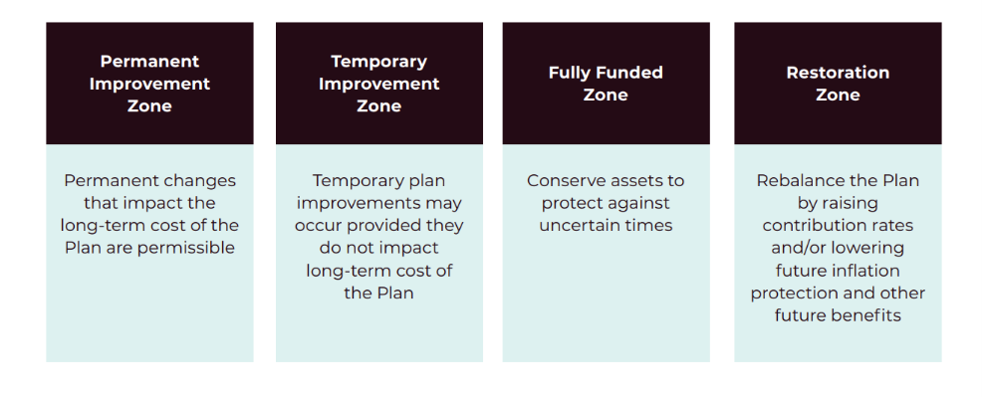
A: Shortfalls could happen in the future. While the plan remains fully funded and has a prudent cushion against potential adverse outcomes, risks remain. These include lower-than-expected asset returns, higher-than-expected inflation, demographic changes, plan maturity, global economic challenges and other events that could increase the cost of future pensions.
The plan manages these risks through a diversified investment strategy and a regular review of actuarial assumptions and funding levers such as contribution rates and conditional inflation protection. These mechanisms help the plan remain resilient through changing market and economic conditions.
A: A future deficit could occur if assets are outweighed by liabilities on a future valuation date. Reserving surplus when a valuation is filed with the regulatory authorities makes it available for investing and earning returns, helping to protect the fund against future deficits. In other words, rather than being a cure, it is a preventative measure against future deficits.
A: Investment performance affects the plan’s funded status by changing the value of the plan’s assets. When investment returns are stronger than expected, the plan’s funded status generally improves; the opposite is true when performance is weaker. However, investment performance is only one factor in the plan’s funding valuation. Funded status also depends on the long-term cost of future pension benefits, which is influenced by assumptions about investment returns, inflation, interest rates, demographics and other risks. As a result, the plan can remain fully funded even when investment markets are challenging or when investment returns differ from benchmarks. OTTP manages the plan with a long-term perspective and a diversified portfolio designed to support retirement security for members over many decades.
A: Annual increases to pensions in pay are calculated by comparing the average Consumer Price Index (CPI) for the 12-month period ending in September to the previous 12-month average (the CPI Ratio). This approach smooths out short-term volatility and is similar to the approaches used by many large pension plans. The current levels of inflation will be factored into future increases to pensions as they flow into the averaging period.
The level of inflation protection provided to members is a plan sponsor decision. When the plan has a funding shortfall, smaller cost-of-living increases help to bring the plan back into balance. When there is a funding surplus, inflation levels may be partially or fully restored.
Pension credit earned before 2010 is 100% protected against inflation. Annual cost-of-living increases for pension credit earned after 2009 are conditional and depend on three factors:
Inflation Protection Levels
PENSION CREDIT | ALLOWABLE LEVELS* | CURRENT LEVELS* |
Earned before 2010 | 100% | 100% |
Earned during 2010-2013 | 50% to 100% | 100% |
Earned after 2013 | 0% to 100% | 100% |
*Percentage of the CPI Ratio.
The current 100% inflation protection level for pension credit earned after 2009 will remain in effect until a subsequent funding valuation updates the amount that is filed with the regulator.
IMPACT ON YOUR PENSION
To see how inflation increases affect your annual pension, register or sign in to your online member account.
A: Pension plan provisions can change over time in response to changing economic conditions, demographics, legislation and the long-term needs of the plan. As a result, no generation of teachers has received exactly the same benefits as those before or after them.
Decisions about plan provisions are made jointly by the plan sponsors and are carefully assessed for their impact on all members and the long-term sustainability of the plan.
Keep in mind that Ontario’s Pension Benefits Act protects the value of pension benefits already earned by working and retired members.
MORE INFORMATION
Find out what three factors determine your annual inflation adjustment.